Pentangle (the Endless Knot)
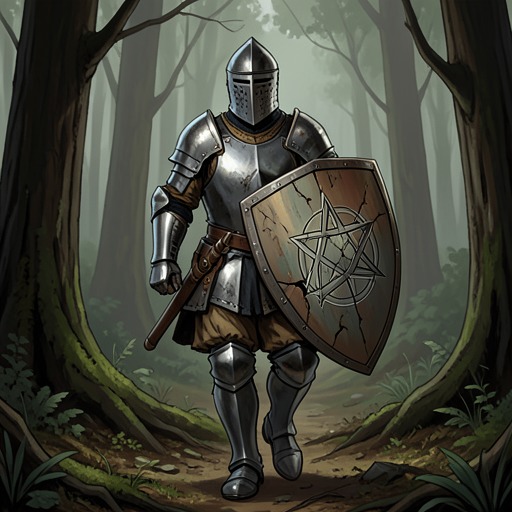
Sir Gawain and the Green KnightThe Pentangle (the Endless Knot) is the gold five-pointed device displayed on Sir Gawain’s red shield and coat. The poem makes it more than decoration: its continuous form signifies truth, and the narrator connects its fivefold pattern to the virtues for which Sir Gawain is renowned. As a visible ideal of constancy, it gives the knight’s reputation a striking emblem—one that gains added force when the story later shows him wearing the protective Green Girdle.
Design and Naming
The device is described as a figure with five points, set in gold on a red field. Its line has no end at any corner: wherever the pattern begins or comes to an end, it remains continuous. The poem says that people call this figure the endless knot, a name that turns its visual form into a concise account of its meaning. The design suggests not a sequence that can be completed, but a joined whole whose parts remain connected.
Truth and the Ideal Knight
The narrator attributes the sign to Salamon, who set it as a token of truth. He then explains why the pattern belongs to Sir Gawain: the knight is known for faithfulness in five ways and in each of five aspects, and is praised as good and pure as refined gold, adorned with virtues. The passage does not enumerate those qualities here; instead, it makes the fivefold design carry the idea of a comprehensive moral ideal. The emblem’s unbroken line and the knight’s reputation are made to reinforce one another.
Shield and Coat
The Pentangle (the Endless Knot) is not left as an abstract figure in the narrator’s explanation. It is placed on Sir Gawain’s bright red shield in pure gold, and the poem also associates it with his coat. The narrator pauses the action to explain the device, stressing both its inherited significance and its particular fitness for this knight. The shield thus presents an ideal to be carried visibly into the adventures ahead: the pattern is both an identifying mark and a statement about the conduct expected of its bearer.
The Green Girdle and the Emblem’s Afterlife
Later, the poem gives a contrasting object a practical force: whoever is girded with the Green Girdle, while it is held close around him, cannot be cut down, as the passage describes it. After the wound in his neck has healed, Sir Gawain wears the gleaming belt at his side. The juxtaposition does not erase the Pentangle’s declared meaning, but it complicates the image of the knight represented by it: an emblem of truth and virtue stands alongside an object associated with bodily protection. The poem’s return to visible signs therefore keeps its ideal in view while showing that Sir Gawain’s story also turns on vulnerability and the need for safety.